
Why isn't traditional
whole-class instruction enough?
In a traditional classroom, the teacher asks a question. One student answers. Everyone else waits.
The student who answers is the student who's learning. The rest of the class — whatever they understood or misunderstood — stays largely invisible until the next question, or the next assessment, or the moment they fall far enough behind to be noticed.
When one student is doing the thinking at any given moment, the rest aren't — and the teacher has no way to know what's actually happening in twenty-five minds at once.
Cooperative learning solves that problem. When students are working in structured pairs and teams — reading together, discussing together, practicing together — every student is engaged simultaneously. The teacher can move through the room, listen to conversations, identify misconceptions in real time, and redirect instruction immediately. Learning becomes visible. Gaps are identified before they widen.

What makes SFA's cooperative learning
different from group work?
Not all cooperative learning is the same. Research is clear on this: cooperative methods only produce significant gains when two conditions are met — a shared group goal, and individual accountability for each member's learning.
Without individual accountability, group work becomes a vehicle for some students to do the work while others stay hidden. With it, every student has a stake in the group's success and hold each other to high expectations of achievement because they know success is possible for ALL.
SFA's cooperative learning structures are built around both conditions:
Group goals
Teams work together toward a common target — points are earned when the team exhibits specific behaviors or reaches shared learning goals. Every team has an equal opportunity to succeed, and teams strive toward a common standard rather than competing against each other.
Individual accountability
Students are assessed individually. There are no group grades. Each student competes against their own past performance, not against classmates, so every student has a genuine opportunity to succeed and improve.
Equal opportunity for success
Because students are competing against their own prior performance rather than each other, improvement is always possible and always meaningful — for the student who was struggling last quarter and the student who was already ahead.
How does cooperative learning
work inside an SFA lesson?
Cooperative learning in SFA isn't a separate activity that happens after instruction. It's woven into the Cycle of Effective Instruction — the framework that structures every SFA lesson.
The cycle moves through four phases:

- Active Instruction — The teacher teaches, models, and guides practice. Clear expectations are set. Students know what they're learning and why.
- Teamwork — Students work in structured pairs or teams to practice the skill just taught. Partners prompt each other, reinforce each other, and practice with real feedback — not in silence, not passively.
- Assessment — The teacher monitors student understanding in real time, moving through the room to observe, listen, and adjust. Students also self-assess. The gap between teaching and learning becomes visible.
- Celebration — Teams and individuals are recognized for effort, improvement, and mastery. Success is shared. The classroom becomes a place where trying and improving are publicly valued.
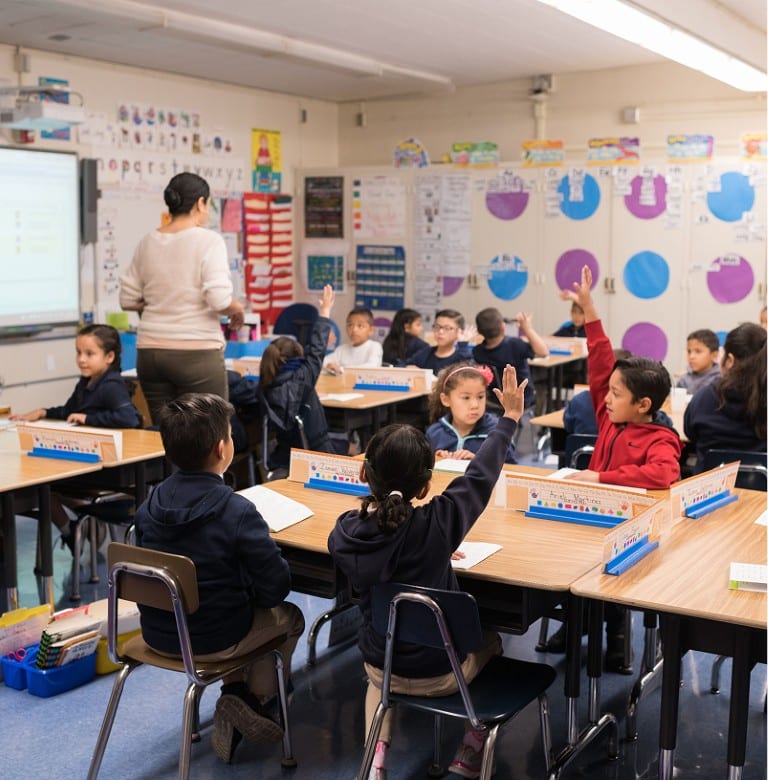
This cycle creates a fundamentally different kind of classroom. Student talk equals or exceeds teacher talk. Every student is actively engaged — reading, thinking, discussing, practicing — not waiting for a turn that may never come.
What does the teamwork phase
look like in practice?
Think-Pair-Share
A teacher poses a question. Every student thinks. Every student shares with a partner. Then a randomly selected student reports for their team. No one can hide and no one is left out.
Random Reporter
After team discussion, the teacher selects any student to report — not the one who always answers. Every student prepares because any student might be called. The quality of team discussion rises because everyone knows their thinking will be represented.
Partner Reading
Students take turns reading aloud to each other, helping each other with difficult words, and retelling what they've read. Fluency, decoding, and comprehension are all practiced simultaneously — with an audience, with feedback, and with accountability.
Team Scores
Teams earn points for academic achievement and for demonstrating cooperation goals. Points are visible and progress is celebrated. The social and academic dimensions of learning reinforce each other.
What does the research say
and why does it matter for your school?
Decades of independent research confirm what SFA schools experience every day: structured cooperative learning — when it incorporates group goals and individual accountability — consistently produces significant academic gains across grades, subjects, and student populations.
Slavin (1995) reviewed the research and found a median effect size of +0.32 for cooperative learning methods that incorporated these essential elements — equivalent to moving a student from the 50th to the 63rd percentile. That's a meaningful, replicable result across a wide range of contexts.
Research has also found that cooperative learning strengthens relationships across racial, socioeconomic, and language differences — building the intergroup understanding and mutual respect that make a school a genuinely high-functioning community. For schools serving diverse populations, this is a distinctive benefit that goes well beyond reading scores.


"Students are becoming confident in their abilities as readers and writers — and the consistency across grade-level classrooms is noticeable."
Superintendent
Barberton City School District
Cooperative learning is instruction.
Learn more: Getting Along Together | Instructional Process | The SFA Model